Wednesday, June 6, 2012

Sustainability

If me and my three best friends were stranded on a deserted island and the only supplies on hand are a knife, a blanket, some matches, a water filter, a 1st aid kit, a compass, and a mirror. how will i survive?

Well, using the knife i could use it to sharpen some sticks and create a punji pit for other animals.Next, I can find a natural stream of water and set up the filter so that the flow flows through it and into a cup i carved out of wood with my knife. To sustain my fire, i can build a camp fire away from the elements and stock it up on wood so that it could burn for a long time, then i can measure how long a piece of wood burns, say a log burns an hour, then i find eight pieces of wood bigger or as big to burn over night so that it is still burning in the morn. I could use the blanket to sleep with. Finally I could fashion a spear and fish.
Say my family makes 2000$ a month, now say I pay 1000$ rent, electricity 100$, natural gas 75$, water 100$, car insurance 75$, clothing 50$ toiletries 50$, how can I make it a month for food & gasoline on the remaining amount? If I have to remain on the remaining amount, I could start my own vegetable and fruit garden, while going to places like a farmers market to buy fruit and veggies cheap until my garden grows, I could also only buy things things at the store that is on sale at the time.

In the USA, 50% of electricity comes from burning, and our fuel comes from petroleum and both will run out soon. Our nation can switch to entirely solar, wind, tidal, hydro power (such as dams), and geothermal to ensure clean energy. We could get wind and solar energy esily, but geothermal energy can only be harvested at faults and vents, while hydroelectric energy can only be harvested from building dams that will restrict the migration of fish like salmon and other fish, finally tidal energy is much like dams where the tide will be able to spin turbines that generat electricity. As for fuel, we can always switch to bioproducts like vewgtable oil for gas...it really does work!

Thursday, May 31, 2012

Renewable Energy Resources

Renewable energy resources are ways to gather energy from sources that can be renewed, or at least won't disappear for a long time. Three of these resources are solar (sun), wind and geothermal (heat from the earth). This post will determine the best of the three in California.

Solar energy: Solar energy (hence the name) is energy from the sun.
The sun produces this energy through the process of nuclear fusion: To harness this energy, scientists built flat plates of glass, plastic and metal called solar panels. The total sunlight that reaches earth is only two billionths of the total light that is emitted from the sun. Also, the sun penetrates best through the equator whereas California is a few hundred miles away from the equator. therefore out of five, solar power in California gets a two.

Wind Energy: Wind energy comes from the wind moving the giant blades of a wind turbine with kinetic energy. Wind energy is valuable in California because, on the coast, wind power is the greatest.

Geothermal Energy: Geothermal is a form of heat energy from the earth, hence
geo=earth, and thermal=heat. Geothermal is best used in areas where molten rock is either easily accessible like a fault line or close to the surface like a volcano. California is directly on the San Andreas fault so geothermal energy is abundant. Geothermal energy is made from injecting water into the earth close to molten rock to turn it to steam and collect it to spin a turbine.

Tuesday, April 24, 2012

CST

Here are some helpful hints for taking tests like the CST:
  1. Analyze how you did on a similar test in the past.
    Review your previous tests and sample tests provided by your teacher.
    Each test you take prepares you for the next one!
  2. Arrive early for tests.
    List what you need beforehand to avoid panic.
    Good preparation prepares you for the task at hand.
  3. Be comfortable but alert.
    Choose a comfortable location with space enough that you need
    Don't slouch; maintain good posture.
  4. Stay relaxed and confident.
    Keep a good attitude and remind yourself that you are going to do your best.
    If you find yourself panicking, take a few deep breaths
    Don't talk to other students right before: stress can be contagious.
  5. Read directions carefully!
    and avoid careless errors.
  6. If there is time, quickly look through the test for an overview.
    Scan for keywords. If permitted, jot any notes that come to mind.
  7. Answer questions in a strategic order:
    Easy questions first to build confidence.
    Then those with the most point value.
    On objective tests, eliminate obvious incorrect answers.
    On essay tests, broadly outline your answer and sequence of points.
  8. Review! if you have time.
    Resist the urge to leave when you complete the exam--
    check if you have answered all the questions,
    and not made any errors or mis-marked any answers.
  9. Change answers to questions if you erred, or misread the question!
    You may also find information in the test that will correct a previous answer.
  10. Decide on and adopt study strategies that work best for you.
    Review where you succeed and where you are challenged.
    Check out your academic support center or a trusted teacher for advice.
Caffeine helps you on a test because it widens the capilaries in your brain to allow faster blood flow. Sleep also helps by clearing your mind and scientists have shown that sinse your brain never stops in sleep then it solves problems while you are asleep. Breakfast helps because it energizes the brein with sugars. Exersise helps by in creasing blood flow to the brain.

Thursday, March 22, 2012

The Galileo Mission

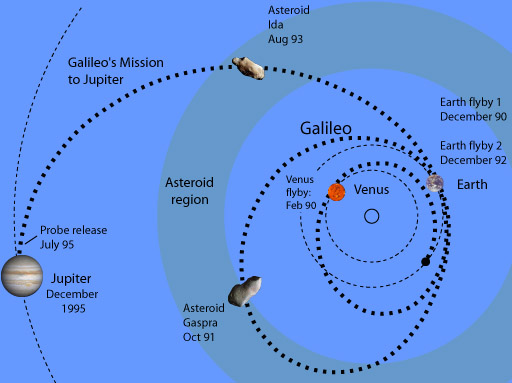
The Galileo Missions plan was to fly a satellite directly to Jupiter and gather Intel on it and a few of its moons. After new problems were placed on shuttle operations after the Challenger accident and the Centaur program was cancelled, Centaur was a new booster to lift heavy payloads by using liquid hydrogen and liquid oxygen as fuel. They fixed this problem, however by using Earths & Venuses gravity to "slingshot" the craft to Jupiter.
During the flybys of the earth, Galileo was able to get pictures of the moon.  Finally on July 1995, the Galileo probe was released and began its long lonely flight to Jupiter. Five months later, the probe sliced into Jupiter's atmosphere at one-hundred-six-thousand miles per hour. It slowed, released its parachute, and drop its heat shield. As the probe descended through ninety-five miles of the top layers of the atmosphere, it collected fifty-eight minutes of data on the local weather. The data was sent to the spacecraft overhead, then transmitted back to earth. On September 29 2003, Galileo commit suicide by flying into Jupiter's crushing gravity to not risk contamination of the new found ocean under the icy surface of Europa.
Here is a complete timeline of the mission.
TimeEvent
1989-10-18Launch on Space Shuttle Atlantis
1990-02-10Venus Flyby (16,000 km)
1991-04-11High gain antenna fails to open properly
1991-10-08Earth Flyby 1 (960 km)
1991-10-29Asteroid Gaspra Flyby (1,600 km)
1992-12-08Earth Flyby 2 (305 km)
1993-08-28Flyby of Ida and its moon Dactyl (2,400 km)
1994-07-16Direct observation of comet S/L-9 Jupiter Impact.
1995-07-13  05:15Jupiter Probe separation
1995-07-27  06:45Trajectory correction maneuvre (orbiter deflection) - on target for orbit insertion
1995-11-19Jupiter Bow Shock Crossing
1995-12-07  13:09Closest approach to Europa during Jupiter orbit insertion (30,951 km)
1995-12-07  17:45Closest approach to Io during Jupiter orbit insertion, used as a gravity-assist (892 km)
1995-12-07  21:53Jupiter Orbit Insertion: closest approach to Jupiter (214,569 km)
1995-12-07  22:04Probe enters Jupiter atmosphere
1995-12-07  22:2249 minute Jupiter Orbit Insertion burn starts
1995-12-08  00:27Jupiter Orbit Insertion engine firing for 49 minutes
1996-03-14Apojove maneuvre
1996-03-14  19:15Perijovie raise maneuvre
1996-06-27  06:29(1) Ganymede Flyby (835 km)
1996-06-28  00:31Perijovie (11.0 RJ)
1996-09-06  19:00(2) Ganymede Flyby (262 km)
1996-11-04  13:34(3) Callisto Flyby (1,100 km)
1996-12-19  06:53(4) Europa Flyby (695 km)
1997-02-20  17:03(6) Europa Flyby (588 km)
1997-04-05  07:10(7) Ganymede Flyby (3,065 km)
1997-05-07  15:57(8) Ganymede Flyby (1,584 km)
1997-06-25  13:48(9) Callisto Flyby (416 km)
1997-09-17  00:19(10) Callisto Flyby (524 km)
1997-11-06  20:23(11) Europa Flyby (1,119 km)
1998-02-10(13) Europa Flyby
1998-03-29  13:21(14) Europa Flyby (1,645 km)
1998-05-31(15) Europa Flyby
1998-07-21(16) Europa Flyby
1998-09-26(17) Europa Flyby
1998-11-22(18) Europa Flyby
1999-02-01(19) Europa Flyby
1999-05-05(20) Callisto Flyby
1999-06-30(21) Callisto Flyby
1999-08-14(22) Callisto Flyby
1999-09-16(23) Callisto Flyby
1999-10-11(24) Io Flyby
1999-11-26(25) Io Flyby
2001-01-04Closest approach to the Cassini spacecraft (4,500,000 km)
2002-11-05Amalthea Flyby. Last flyby at a Jupiter moon for Galileo (159 km)
2003-09-21  05Passes Ganymede orbit for the last time
2003-09-21  12Passes Europe orbit for the last time
2003-09-21  15:20Passes Io orbit for the last time
2003-09-21  18:57Deliberate impact into Jupiter atmosphere


Wednesday, March 7, 2012

The celestial sphere, eliptic & presession

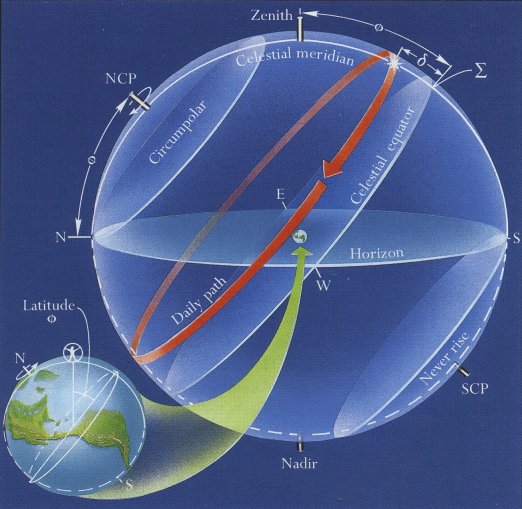
This is a Celestial sphere, an imaginary sphere of a large radius encircling the Earth and rotating upon the same axis, concentric with the Earth. All objects in the sky can be thought to be projected onto the sphere. The celestial equators and celestial poles are projected right above the earths equator and poles.


This is a diagram of an ecliptic, the supposed path that the Sun travels throughout the year, tracing an imaginary line on the celestial sphere, which is intersected by the ecliptic of the earth (The Geometric plane) in which the earth orbits the Sun. The name refers to the fact that when the full or new moon meets the Sun on its path.
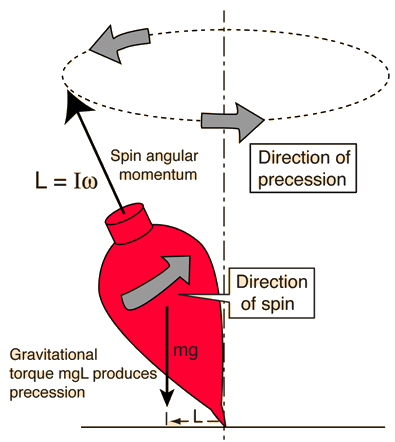
This is a model of precession, a change in the orientation of the rotation axis of a spinning object. It can be defined as a change of direction from the rotation axis.

Wednesday, February 15, 2012

Hurricanes and Tornadoes

Facts about Hurricanes:
  • Winds are usually greater than 75 mph
  • It begins over the sea with low air pressure
  • The eye is 30-100 miles wide
  • They occur on coastal areas
  • They are also called typhoons
  • Hurricanes also cause floods
  • They die when they reach land
Facts about Tornadoes:
  • Trees and cars may be picked up and carried.
  • Tornadoes are most common in North America.
  • It usually begins and ends suddenly.
  • Winds are greater than 300 mph.
  • They often begin in a thunderstorm over land.
  • The eye is several yards wide..
  • Usually moves in a Southwest or Northeast direction.

Hurricane:


Tornado:

Wednesday, February 1, 2012

Chapter 18-19 Notes

18.1 Water in the atmosphere,

Key concepts
  • Water vapor is the most important gas in the atmosphere for understanding atmospheric processes.
  • The process of changing state requires that energy is transferred into the form of heat.
  • When saturated, warm air contains more water vapor than cold air.
  • Relative humidity is a ratio of the airs actual water vapor content compared to the amount of water vapor needed for saturation at the current temperature & pressure.
  • When the water vapor content of air remains constant lowering air temp. causes an increase in relative humidity and raising air causes a decrease in relative humidity.
18.2 Cloud Formation,
  • When air is allowed to expand, it cools, and when its compressed it warms up.
  • Four mechanisms that can cause air to rise are orthographic lifting, frontal wedging, convergence, & localized connective lifting.
  • Stable air tends to remain still while unstable air rises.
  • For any kind of condensation to occur, the air must be saturated.
19.1 Understanding Air Pressure
  • Air pressure is exerted in all directions. up, down, and sideways. The air pressure pushing down on the object exactly balances the air pressure pushing up on it.
  • Wind is the result of horizontal differences in air pressure. Air flows from areas of higher to areas of lower pressure.
  • Three factors combine to control wind: pressure differences, the Coriolis's effect, & friction.
  • The Coriolis effect depicts how the rotation of the earth offsets the winds destination by 15 degrees.
19.2 Regional Wind Systems
  • The local winds are caused by topographic effects or by variations in surface composition -land & water- in the immediate area.
  • In the united states, the westerlies consistently move weather from west to east across the country.
  • When surface temps in the east pacific are colder than average, a La Nina event is triggered that has a distinctive set of weather patterns.

Wednesday, January 18, 2012

Precipitation

Temperature inversion affects smog when there is an increase in temperature and CO2 in the atmosphere above major city's, like Las Vegas, will heat up and combine with other gasses to form a giant killing cloud.

The average humidity following the course of a year in Florida is 61% for the lowest is 56% and the highest is 68%. In Beijing, China, the average humidity is 73%, and while in Hawaii it is about 78% the average between 73 & 81.

The "Bergeron and Collision-Coalescence" and how they affect precipitation:
Most precipitation that falls to earth's surface originates through the Bergeron process. The process requires the presence of water vapor, ice crystals and supercooled liquid water droplets (water that has been cooled below the freezing temperature, but is still a liquid form). In "cold" clouds (usually-10 degrees Celsius to -20 degrees Celsius), water vapor deposits on the ice crystals. Hence, the ice crystals grow larger while the supercooled water droplets lose mass, that is, there is a migration of mass from the supercooled droplets to the ice crystals. As the ice crystals grow larger and heavier, they start to collide and coalesce with water droplets and ice crystals in their path, thereby growing still larger. Eventually, the ice crystals become so heavy that they fall out of the cloud. If the air below the cloud is above freezing, snowflakes melt and fall as raindrops, but collision-coalescence also has to go through the Bergeron process.